Dash, Crash, Dash: Horizon Scanners, Black Swans and Capital’s Futurecraft
Ho Rui An
(Print essay)On 14 May, 2012, a video showing a horrific crash between a Ferrari and a taxi at an intersection in downtown Singapore, shot by a dashboard camera of another vehicle, started making its rounds on the Internet.1 The collision had taken place two days before in the early hours of a Saturday. Both drivers did not survive. Of the half-minute clip, the Ferrari in question was seen for less than a second as it tore across the junction in a blur of hot red, beating the red light and ramming the taxi, releasing a puff of debris as it did. The devastating impact, made more unfathomable by its pixelated document, shocked the residents of the orderly city-state where such recklessness is unheard of.
But the traumatic nature of the accident was not all that stirred the local population. As more details emerged over the days, another narrative of collision imposed itself. As it turned out, the Ferrari driver was an affluent financial investor from China, part of the recent influx of professionals shifting base to the country well known for being a tax haven. Rumors circulating among netizens in China even connected the man to the Chinese mafia and money-laundering operations in Hong Kong. Given this, the businessman’s limited-edition Ferrari was seen by most Singaporeans as a vulgar sign of the nouveau riche in the country who flaunt their illegitimately acquired wealth.
In fact, resentment against the pegging of the country’s immigration policy to an economic imperative to pursue compound growth at all costs has been rising in recent years. This reached a tipping point in early 2013 when a government-issued white paper planning for population growth from the current 5.3 million to 6.9 million in 2030 was met with a ferocious public backlash.2 Given the country’s declining birth rates, this target was expected to be achieved by a massive inflow of foreign labor, which would include both highly skilled professionals and low-paid workers in the construction and service sectors who are barely protected under the state’s limited labor laws. In response, critics charged that this obsession with hitting growth figures belies the increasingly uneven social landscape that has seen wages stagnate for lower-income brackets and social tensions heighten.
No wonder then that all the sympathy on the ground was reserved for the other victim in the crash: the taxi driver. In this man, who perished because of another man’s need for speed, the people found a brutal representation of the local working class crowded out by the state’s unchecked economic agenda. On one side, darting out of nowhere, was a madman investor who, seemingly fused with his machine, came to embody speed in its roaring automatisation, figured first as fetish by the fevered aspirational class charging forth, then as excess by the besieged precariat increasingly feeling the discontents of the island city’s inundation by foreign labour and capital. And on the other was an everyman driving in order to make a living, stolidly working his machine as it worked upon him, for whom speed was a matter of traffic, of sticking to the rules and following the signs. The collision, in other words, took place not between vehicles but speeds. The Ferrari driver was speeding, taking speed beyond itself as it splits from its spatial and temporal coordinates, leaving no more than the smell of burning.
My sense is that this concentration of public affect around an event that happens to be a traffic accident is not incidental. Indeed, it strikes me that so many of the recent incidents in Singapore that have been narrativised as confrontations involving the country’s growing immigrant pool happened around scenes of traffic (or its interruption). For one, in November of the same year of the crash, the country’s first strike in over twenty years involved some 171 bus drivers, all Chinese nationals, who protested against wage disparity and poor living conditions. But nothing was more astounding than the riot that broke out a year later in Little India, a weekend spot for the country’s South Asian migrant workforce, that was sparked when a motor accident that killed an Indian construction worker escalated quickly into total carnage as an angry mob formed around the vehicle. Involving over three hundred workers and lasting over two hours, the riot was the country’s first in forty years.3
Add to these the nagging complaints surrounding the city’s increasingly visible urban strain, manifested most in the repeated breakdowns of the public rail system that leave commuters “stuck”—catastrophic for a country that boasts of its punishing efficiency—and one finds an anxiety for the future articulated through an imaginary that is, above all, infrastructural. Yet this must be no surprise for a city-state gripped by a perennial anxiety over its small size, and can thus only see its future as infrastructure, evidenced by the continued elevation of its skylines and extension of its shorelines, often through remarkable feats of geo-engineering4. In turn, what such technologically powered projects of relentless extension produce is a skirting of the structural conditions that pertains to the distribution of the social, as it substitutes movement for change, politics for the political. As Paul Virilio cautions, “revolution is movement, but movement is not a revolution”.5 Truly, within a politics of speed, the most political act may very well be that of standing still.
But the government is not oblivious to the possibility of such systemic failures. After all, for the small city-state, a sense of vulnerability always overrides any provisional mastery of the horizon. And more and more, it’s likely that the next crisis will be an internal rupture, a crash for which the conditions are already written into landscape and yet too often evade recognition. This loss of the horizon as a space of understanding is not exclusive to Singapore, but symptomatic of a world where, following the securitisation crisis of 2008, all manner of approaching the future based on the faux certainties of probability and prediction has been suspended. Ironically, the mediation of this traumatic loss through the propulsive engine of capital continues to demand the reconstruction of the horizon as a precarious object of vision/knowledge, if only so as to sustain its forward rush. As if despite all the uncertainty of the world today, the only certainty that must remain is that of moving forward.
Accordingly, what emerges as a subject for scrutiny is the insanity, or the “irrational rationaliser",6 that fuels this optical-motor complex and that finds its expression in the figure of the retooled, post-crash futures analyst. That is, the figure looking out from the dashboard as it passes on from the scene of the accident, at once reckoning with the crash and dashing into the horizon without pause. It is to this figure that I shall devote the rest of my reflections.
Horizon Scanners
On 14 October 2014, Peter Ho, a senior advisor working in the Centre for Strategic Futures in Singapore, opened his speech to the public sector with a reference to the 2009 cinematic reboot of Star Trek7. In the scene that he described, the young James Kirk is being reprimanded by Spock for cheating during the infamous no-win simulation exercise, the Kobayashi Maru, by secretly reprogramming the test. Defending his actions, the cadet retorts that cheating is justified in an unfair system. Spock counters that he had missed the point of exercise: “The purpose is to experience fear. Fear in the face of certain death. To accept that fear and maintain command of one’s self and one’s crew. That is a quality expected in every Starfleet captain.”

Ho used the excerpt to make the point that in today’s complex and dynamic systems, the future has become impossible to codify and master. Instead, we must learn to face the future in all its uncertainty, including the ultimate uncertainty of a certain death. Deprived of an objective set of formulas to predict the future, we must learn to simultaneously read and unread the horizon—an exercise not simply in making sense, but also in sensemaking. As Ho and his colleague Adrian Kuah elaborate, “sensemaking is not about the ‘truth’ and ‘getting it right’; rather, it consists in the continuous drafting (and redrafting) of an emerging story”.8
This turn away from the positivist sciences to what is effectively a speculative aesthetics resonates with the refiguration of the horizon current in other philosophical discourses—of which the Anthropocene is most prominent—that sees the horizon no longer as a space of human mastery but where nature comes to enact its geological vengeance. And like the term 'Anthropocene' itself, the speculative tenor taken on by such new futures imaginaries continue to retain some repurposed notion of the human in a desperate bid to reclaim agency in world that seems to have lost all moorings.9 Yet, what form can so whittled an agency take?
One thing is for sure: the presumption of the ambition of omniscience that undergirds most critiques of big data and computerised speculation grossly simplifies an actuarial complex that has become far more self-conscious and anxiety-ridden than we’d like to acknowledge. Unsurprisingly, such critical missteps are too often made by liberal commentators from the West who can only see any given state-run big data programme through the form of surveillance. Consider, for instance, a widely circulated article published in 2014 by Foreign Policy, profiling what can be considered the centrepiece of Singapore’s futures programme: the Risk Assessment and Horizon Scanning (RAHS) programme.10 Locating the genesis of the programme in a meeting that Ho, then the Permanent Secretary for Defence, had in October 2002 with the Defense Advanced Research Projects Agency (DARPA) in the US, the article drew a narrative that essentially positioned Singapore as the fully realised big data–powered “social laboratory” that did not come to fruition in the US due to its pro-privacy culture.


As the writer recounts, Ho had travelled to the US to meet John Poindexter, one of DARPA’s senior directors, to learn more about a data-mining programme that his office was building under the name Total Information Awareness (TIA). Developed as a counterterror weapon, TIA was designed to collect large amounts of electronic data to be analysed for suspicious activity. Inspired, the civil servant went on to pilot a similar programme in Singapore when the SARS regional outbreak several months afterwards provided the crisis required to put the programme to the test. By feeding the programme with the public data that were available in the months preceding the outbreak, the Ministry wanted to know if they could have pre-empted its occurrence. The results proved incredibly encouraging. And from that was born the RAHS programme that would, over the years, extend its scope beyond national security to all levels of governance, notably including the integration of the country’s rising immigrant population.
But as compelling as this story sounds, certain assertions should give us pause. Apart from the unfounded suggestion that the programme, like its US counterpart, was prying into private data—this is likely already well covered by more established arms of state intelligence—the article misunderstands the programme’s epistemological premise and organisational logic. For one, there are no “armies of civil servants” logged onto the programme; the key people managing the programme—the futurists—occupy a position that is more exceptional than the norm. To appreciate why this must be so, one simply has to trace the beginnings of the country’s futures programme further back to the 1990s when it was still based on the well-established scenario-planning methodology. This old model typically involved engaging a small outfit of futurists to research a set of possible futures and was made famous by the team at Royal Dutch Shell said to have successfully prepared the company for the oil shocks of the 1970s.11
Today, scenario planning is regarded by the Singaporean government to be too linear in its extrapolations to cope with the contingencies of the globalised world. Yet, its fundamental investment in futurecraft as, above all, a speculative art remains. As one futurist related to me, the most important quality required of a futures thinker is their ability to provoke, even offend. After all, if the futures they generate are within the realm of expectation, their presence will not be required. Yet, it is also by speaking the unspeakable that the futurist may jeopardise their standing within the organisation. To quote the original Shell scenarios-planning team, the futurist is to be “tolerated but not embraced”.12
Furthermore, what adds to the futurist’s status as other to the bureaucracy is their necessary redundancy. They must be only person in the office granted the privilege of relieving themself from the immediacies of the present so as to dream about the future. Ted Newland, a founding member of the Shell scenario-planning team, recalls: “I was placed in a little cubicle on the 18th floor and told to think about the future, with no real indications of what was required of me.”13 Likewise, this freedom accorded to the futurist in Singapore today is reflected in the very name used to describe their work: not “policy planning”, but “policy gaming”. But perhaps the best designation for the futurist is the “policy poet”, a term coined by the futures thinker Marcus Bussey to describe the mavericks in any organisation that sees a given situation not as a problem to be solved but a field of potential meanings to be mined.14 Given the number of actual published poets who fill the ranks of the civil service in Singapore, this term takes on a curiously literal register. The late Lee Kuan Yew, the country’s venerated former Prime Minister, who once quipped that “poetry is a luxury we cannot afford” may have to eat his words.
While this refashioning of policy work as aesthetic labour may seem rather incredible, no less in Singapore, its logics are well-founded upon a challenge to yet another assumption in the article: that having more data means more power. As we know, any kind of raw data need to be first processed before they can yield any valuable information, such that too much data can be burdensome. This is especially the case with the RAHS programme that is designed not to be a fully automated system, believing that the algorithm should assist but never replace the analyst. To quote Ho, the technological interface is not a “silver bullet” but a tool “to augment the analyst by helping to automate some of the more tedious aspects of research work... It cannot replace instinct and it cannot ask the right questions.”15 Ho emphasises that this is especially so in the case of “weak signals or outliers” that can easily be missed by a machine trained to look out for well-established patterns. And so often it is through this failure to prepare for an event without precedent that the stage for a disaster is set.
Black Swans
The key concept informing Ho’s thinking here is the black swan, a term coined by the risk analyst Nassim Nicholas Taleb in his book of the same title to describe rare, unpredictable events of great consequence that are rationalised only in hindsight.16 The term 'black swan' refers to how it was believed that all swans were white until black swans were discovered in Australia. The radical provocation of Taleb’s concept is that all existing models of futures thinking based on prediction or probability had to be overturned, for there is nothing within the existing data sets that can instruct us about what is to come. As Taleb puts it, “we are drivers looking through the rear view mirror while convinced we are looking ahead”.17
Taleb believes that more than ever we are living amid black swans; indeed, they are becoming larger, often taking on a global scale, and are more difficult to detect. He attributes this to the expansion of the informational, networked economy, the exemplar of which is global finance. His explanation is simple: the scalability inherent to the economy of abstraction removes virtually all limits to how large a phenomenon can grow, so much so that the bursting of one single bubble, coupled by a hyperconnected and deregulated network, can have world-changing effects.18
It was no accident that The Black Swan was published in April 2007, just before the bursting of the housing bubble in the US and the subsequent collapse of the shadow banking system that would send the global economy on a downwards spiral. Fed by the double fantasies of ever-rising property prices and complex mathematical formulas that could somehow distribute away all manner of risk, the accumulation of toxic mortgage-backed securities went on unchecked by a financial machinery that passed off its increasing indebtedness as surplus liquidity. In the aftermath of the crisis, responses made by critics have sought either to pathologise the rogue bankers or ontologise finance,19 yet I wonder if it would not be more precise to consider how in this extraordinary entanglement between Man and his machine of abstraction, what comes to be produced is a collapse of the line between fraud and negligence as we know it into the profoundly contemporary condition of willful ignorance.
In a time of financial engineering, what needs to be reckoned with is a newly minted conception of risk, which has become “abstracted from the relatively concrete universe of uncertainties” yet “determinative” because it forms the basis for pricing derivatives that end up producing the uncertainties they were devised to manage.20 As Elena Eposito notes, derivatives, as instruments designed to exploit the difference between the expected future and the actual future, effectively sabotage themselves by setting a monetisable parameter around this difference to which the actual future then reacts and undoes.21 Never has so much knowledge been generated around uncertainty with us remaining ever more... uncertain.
Given the surprise that the crisis took most people by, many commentators were quick to classify it as a black swan. But this eagerness to embrace the theory, by projecting these conditions onto the external space of the 'accident', can only too easily become an alibi for not taking stock of the structural conditions that produced the crisis. Such is the seduction of the black swan as a conceptual lever for any system bent on maintaining its fundamental logics while still conceding at some level its fallibility. In fact, at times, the black swan, defined as the accident over which we can have no control, is used not just to designate the limits of the given system but also to push at those very limits.
The (un)helpful irony that Taleb’s book provides us here is that for a text that insists upon the unpredictability of the black swan and dismisses the possibility of its narrativisation, it is chock-full of metaphors and anecdotes, from the story of Casanova’s unfailing luck to Taleb’s own experiences as a derivatives trader. Indeed, it is likely on this cue that Ho and his colleagues retooled the scenario-planning model as the multi-faceted virtual environment that the RAHS interface is today, one where analysts can use the available data to generate “narratives” that are then shared across the civil service for others to elaborate upon them or pick them apart. The aim here is no longer to foretell discrete events but to create an ever-renewing catalogue of stories around the slightest blips on the radar, tentatively using these microfictions to prop up the collapsed horizon of expectation. With this, we see the black swan resurrected as a kind of (de)constructive limit-metaphor—denouncing metaphoricity even as it makes the denouncement the enabling condition for producing new metaphors. That is, it is exactly because we can never come up with a metaphor adequate to the future that we must, for metaphors are all we have. The end of one metaphor begetting another, the new futures analyst is the indefatigable storyteller.
Given this, any critique of big data and computerised speculation today cannot afford to gloss over the human reincorporated as supplement to the machine, such that the issue concerns no longer just metadata but also something more like metaphysics. How else can one approach the condition of these analysts, who are in many ways disempowered, straining their imaginations at the limits of the thinkable? How else can we bear the post-probability dissolution of the horizon as a space into which we must proceed but by obsessively circling it in hope of finally breaking and entering?
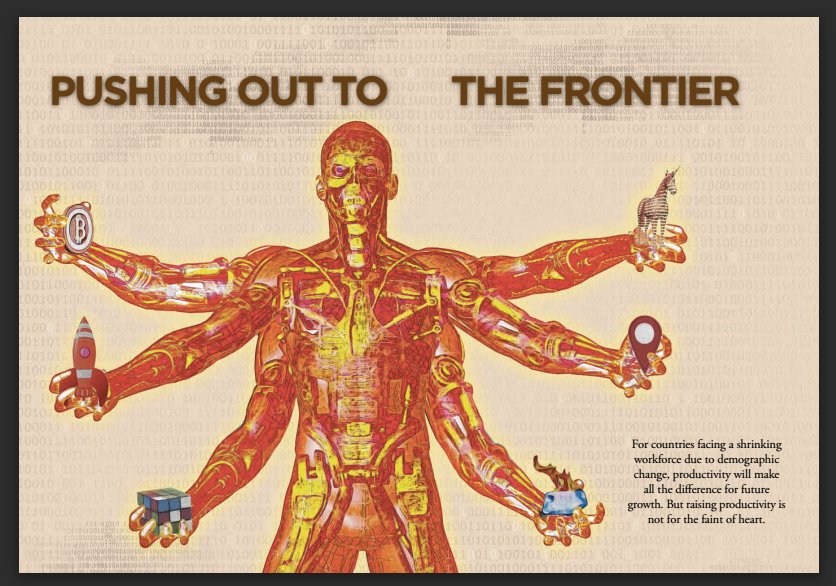
Illustration imagining the extension of the Singapore economy to reach new frontier markets in Future Tense, a periodical by the Singapore government.
Source: Ministry of Trade and Industry, Singapore.
Opening, Foreclosure
In the 2011 Singapore general elections, the ruling People’s Action Party (PAP) suffered its worst election results since the country’s independence, winning eighty-one out of the eighty-seven elected seats. While such figures would translate into a comfortable mandate in any other democracy, it was a disaster for the party that had governed the city as a de facto single-party state. In an effort to address the issues that had surfaced through the elections, the government initiated a nationwide citizen engagement initiative about a year later called “Our Singapore Conversation”, effectively a series of workshops facilitated by ministers and civil servants open to anyone who signed up. Styled as “collective national storytelling” session, the Conversation distinguished itself from previous consultation exercises by its declared lack of an agenda and open-ended structure. All the participants were called upon to do was to spontaneously tell their stories.22
Quite fairly, skeptics saw the exercise as pure political tokenism. But this critique misses the key point. For, despite all its liberal posturings, the Conversation was, at its base, an extensive data-gathering exercise that formed an essential cog within the government’s futures infrastructure. And, once again, as in the RAHS programme, the figure of the analyst constituted the most essential part of the operation. But more so than the former programme, the Conversation, in emphasising direct contact between the analyst and their subject, marked a decisive shift away from 'big' data to the 'small' sensemaking workshop, using the format of the intimate sharing session to tease out all kinds of tacit and embodied narratives that cannot be captured by a hashtag. This was storytelling in its most ancient form, a kind of close listening that sought to draw out whatever was seething beneath the surface of things.
To this end, one can see the initiative as a genuine attempt to understand certain conditions in the country at a structural level, to attend to the deep narratives upon which all the individual stories are built. The only problem with this reading, however, is the unfortunate reality that this attentiveness, however generously bestowed, is countered by a prevailing logic that sees no alternative to the system that is presently in place. Driving home this point is the aforementioned controversial white paper on population that was published in the midst of the national conversation. Public protestations led the government to scale down its figures, but the fundamental rubric that sees the possible social costs of the population forward drive as mere 'tradeoffs' to the economic gains remained. But perhaps this depletion of the political imagination was to be expected, foreshadowed by a dialogue that was held in late 2011 with Deputy Prime Minister Teo Chee Hean, who would oversee the drafting of the white paper. When the Minister was questioned on whether he could imagine a Singapore without the PAP, he feebly offered that he could. But when pressed to answer if he saw in the current political scene the viability of another party taking power, the reply was unequivocal: “I don’t.”
How does one reconcile this overzealous opening of the political on one hand and its abrupt foreclosure on the other? Perhaps the best people to ask are the futurists themselves. This is given that too often they find themselves in a position where they are tasked with changing the system from within while still having to indulge the persisting expectation that the system is one to be defended rather than transformed, to which any shock is conceived as external. As one futurist told me, given such conditions, his can only be the art of the “nudge”, of trying to “obliquely” shift the institution away from its determined path. This is an awkward position fraught with tension, where the futurist is on one side making a “genealogical” turn, as Foucault would have it, to the self-proximate structural conditions that produce his existence, while, on the other, still servicing an infrastructural imaginary in which one’s gaze is kept looking firmly ahead.
No doubt this structure-infrastructure opposition I am proposing here bastardises the meaning of the “infra”, which usually suggests a coming from behind. Yet such is the perverse logic that contemporary infrastructure has taken on: it no longer just constitutes us from behind, but also fills up the horizon before us, so that all possible roads can only point forward. Understood as such, infrastructure is not a fixed thing, but “a means to craft a multitude of interdependent relationships and sequences”, lending the horizon a structure without determining its contents.23 Ultimately, if change is to take place, it is only as an extension of the same; in other words, for every new problem, we would be compelled to blaze open new roads to stretch the limits of the system without thinking if it is the system that is the problem in the first place. Would the futurist be able to resist the rush?
To this effect, one can read the entire premise of Singapore’s futures programme as a gross overreading of Taleb’s proposed solution of “antifragility” to the problem of black swans; that is, the loosening up of a given system at its political base—not to be conflated with the “freeing” of the economy through financial deregulation—so that instead of trying to deflect shocks it can never anticipate, it absorbs them and learns from them.24 The problem with this in Singapore is that instead of freeing things up, it adds devices of flexibilisation like an untidy workshop or two, or, put more crudely, it attempts to reengineer spontaneity into a hitherto wholly determined system. But is that perhaps the only way that antifragility can be realised within the capitalist state? Is the only alternative to the good old macho hierarchies of establishment capitalism the more pliable masculinity of a scenario-driven, plugin-powered hyperextensionism? Should we then not be talking about the futurecraft of capital but capital as futurecraft?
After all, it is exactly the power of capital to ingenuously transform any limit it encounters into a barrier to be transcended or circumvented, taking the next crisis as an occasion to further hone its craft. This is why, as David Harvey explains, theorists who focus on moments of rupture miss the bigger picture themselves, for it is the movement and uneven development that happen across them that counts.25 Or to remap this onto the imaginary of the road, it is neither the physical infrastructure of the road nor the accidents along it that are constitutive, but the infrapower propelling the vehicle from behind, the propulsional force, that makes a necessity out of movement, bursting through the seams of nation-states to assume a truly planetary scale. Consequently, the image we are confronted with is no longer Marx’s old-fashioned metaphor of ideology as a camera obscura inverting reality. Rather, it resembles more of a heady charge into the horizon, exemplified best by the view of the dashcam hurtling on from the crash. This is the image through which we produce ourselves forth into an unknown yet inevitable future, letting out an exalted gasp as we do, wherein the persistence of vision demands nothing less than the persistence of movement.
Dash, Crash
I find myself back at the scene of the Ferrari–taxi crash. Except that this time, instead of looking at the crash, my attention splits to the exclamations of relief that I can hear from the dashcam footage as the vehicle drives on from the crash. I hear especially the word “Lucky!” that is the cry made by the man behind the dashboard as he escapes the accident by accident. It is the cry that one makes in surviving this game of contingency, emerging not just unharmed but victorious. The cry that speaks to a time when prediction and probability have ended, releasing the libido to be reinvested in a new set of speculative crash fictions, all of which serve to confirm our forward rush. Are we doomed to repeat the cycles of speculation, crisis, securitisation, crash, to which “Lucky!” is the best response we can muster?
Or perhaps we can seek another view. The view of the other dashcam that may or may not exist, that regardless of its physical availability, is already rendered spectral at one level. I’m talking about the camera that may or may not be installed on the dashboard of either the Ferrari or the taxi. Granted, while no footage has, to my understanding, been recovered from the vehicles, we can speculate on this truly occulted view from similar footages on the Internet. In the most unsettling of such footages, one finds oneself having to inhabit a viewpoint that has somehow been killed, yet still there—spectralised. The body, no longer moving, continues to take in and take time, a time that however can no longer be reduced to the still-plodding clock. A time that for all its uncanniness is not “out there”, but resolutely in the “here-now”, bearing down upon us as “an ordeal, a test, a crucial moment through which we have to go”.26
This is the image of the crash itself, from which we cannot look away.
-
“Singapore Tragic Accident Video”, YouTube video, 0:28, posted by “TheMockymocky”, 14 May 2012, https://www.youtube.com/watch?v=8JfAaOABk4g. ↩
-
National Population and Talent Division, Singapore, A Sustainable Population for a Dynamic Singapore, January 2013. ↩
-
For a considered reading of the riot against labour conditions of migrant workers in Singapore, see Daniel P. S. Goh, “The Little India Riot and the Spatiality of Migrant Labor in Singapore”, Society & Space, 8 September 2014, http://societyandspace.com/material/commentaries/daniel-p-s-goh-the-little-india-riot-and-the-spatiality-of-migrant-labor-in-singapore/. ↩
-
As it stands today, the current land area of Singapore has expanded by over 20 percent since the 1960s, with the increase made up by decades of aggressive land reclamation projects. ↩
-
Paul Virilio, Speed and Politics, trans. Marc Polizzotti (Los Angeles: Semiotext(e), 2007), 43. ↩
-
David Harvey argues that crises are the “irrational rationalisers of an always unstable capitalism”. I return to this point near the end of this essay. See David Harvey, The Enigma of Capital and the Crises of Capitalism (London: Profile Books, 2010), 71. ↩
-
Peter Ho, “Simulations, Exercises & Games in the Civil Service”, speech given at Civil Service College’s Games Exchange, Singapore, 14 October 2014. ↩
-
Peter Ho and Adrian W. J. Kuah, “Governing for the Future: What Governments Can Do”, PRISM 5, no. 1 (2014): 19. ↩
-
For a far-ranging discussion on the tensions surrounding the Anthropocene, see Donna Haraway and Martha Kenney, “Anthropocene, Capitalocene, Chthulhocene”, in Art in the Anthropocene: Encounters Among Aesthetics, Politics, Environments and Epistemologies, ed. Heather Davis and Etienne Turpin (London: Open Humanities Press, 2015), 255–270. ↩
-
Shane Harris, “The Social Laboratory”, 29 July 2014, Foreign Policy, http://foreignpolicy.com/2014/07/29/the-social-laboratory/. ↩
-
For a brief history of futures thinking in the Singaporean government leading up to the founding of the RAHS programme, see Peter Ho’s foreword in Thinking about the Future: Strategic Anticipation and RAHS, ed. Tan Hong Ngoh, Edna, and Hoo Tiang Boo (Singapore: National Security Coordination Secretariat, 2008), and Conversations for the Future, Vol. 1: Singapore’s Experiences with Strategic Planning (1988–2011) (Singapore: Public Service Division, 2011). ↩
-
As cited in Conversations for the Future, 18. ↩
-
As cited in Angela Williams and Roland Kupers, “Living in the Futures: How Scenario Planning Changed Corporate Strategy”, Harvard Business Review 91, no. 5 (May 2013): 118. ↩
-
Marcus Bussey, “Thinking Policy: Educational Futures in a Time of Edu-Anxiety”, Medium, 22 February 2016, https://medium.com/@MarcusBussey/thinking-policy-educational-futures-in-a-time-of-edu-anxiety-6ce0da9ac437#.kjcx92ps0. ↩
-
Ho, foreword to Thinking about the Future, 5. ↩
-
Nassim Nicholas Taleb, The Black Swan: The Impact of the Highly Improbable (New York: Random House, 2007). ↩
-
Nassim Nicholas Taleb, “Learning to Expect the Unexpected”, Edge, 19 April 2004, https://www.edge.org/conversation/nassim_nicholas_taleb-learning-to-expect-the-unexpected. ↩
-
Taleb, The Black Swan, 26–37. ↩
-
For one of the more impressive and aggressive efforts at formulating an ontology of finance, see Suhail Malik, “The Ontology of Finance: Price, Power, and the Arkhéderivative”, in COLLAPSE: Philosophical Research and Development, Vol. VIII, ed. Robin Mackay (Falmouth: Urbanomic, 2014), 629–811. ↩
-
Edward LiPuma and Benjamin Lee, Financial Derivatives and the Globalisation of Risk (Durham and London: Duke University Press, 2004), 23. ↩
-
Elena Eposito, The Future of Futures: The Time of Money in Financing and Society (Cheltenham, UK: Edward Elgar, 2011), 122-133. ↩
-
For a brief account of the Conversation, see Kenneth Paul Tan, “Our Singapore Stories: Telling National Stories”, Global-Is-Asian 19 (October 2013–January 2014): 1–3. ↩
-
Keller Easterling, Extrastatecraft: The Power of Infrastructure Space (London: Verso, 2014), 80. ↩
-
Nassim Nicholas Taleb, Antifragile: Things That Gain From Disorder (New York: Random House, 2012). ↩
-
Harvey, Enigma of Capital, 132–139. ↩
-
Jacques Derrida, “Time and Memory, Messianicity, the Name of God”, in Jacques Derrida: Deconstruction Engaged: The Sydney Seminars, ed. Paul Patton and Terry Smith (Sydney: Power Institute, 2001), 63. ↩