Note to the Exhibition Design
Claire Humphreys and Kevin O’Brien
(Print essay)Transcribed from the Artist Assembly of Frontier Imaginaries Edition No1 FRONTIER; May 14, 2016.
Claire Humphreys: One of the first questions we asked ourselves when we heard about the exhibition was how to engage with the gallery as a built public institution when the context of the exhibition is so particular in terms of territories, ownership, government control and government funding. Our response is a negotiation with the building rather than an acceptance of it. The relationship between our interventions and the gallery is intended to be tenuous, to the point of feeling a bit awkward at times. We kept signage off the walls as much as possible; we tried to keep work off the walls where possible and appropriate; and that the seating disassembles itself on removal and can be put to a completely different purpose after the show.
This impermanence of the apparatus contrasts the primary intervention on the gallery walls: the cuts into the plasterboard. We applied these strategies to the IMA and it gave out a bit, while the QUT Art Museum was less yielding.
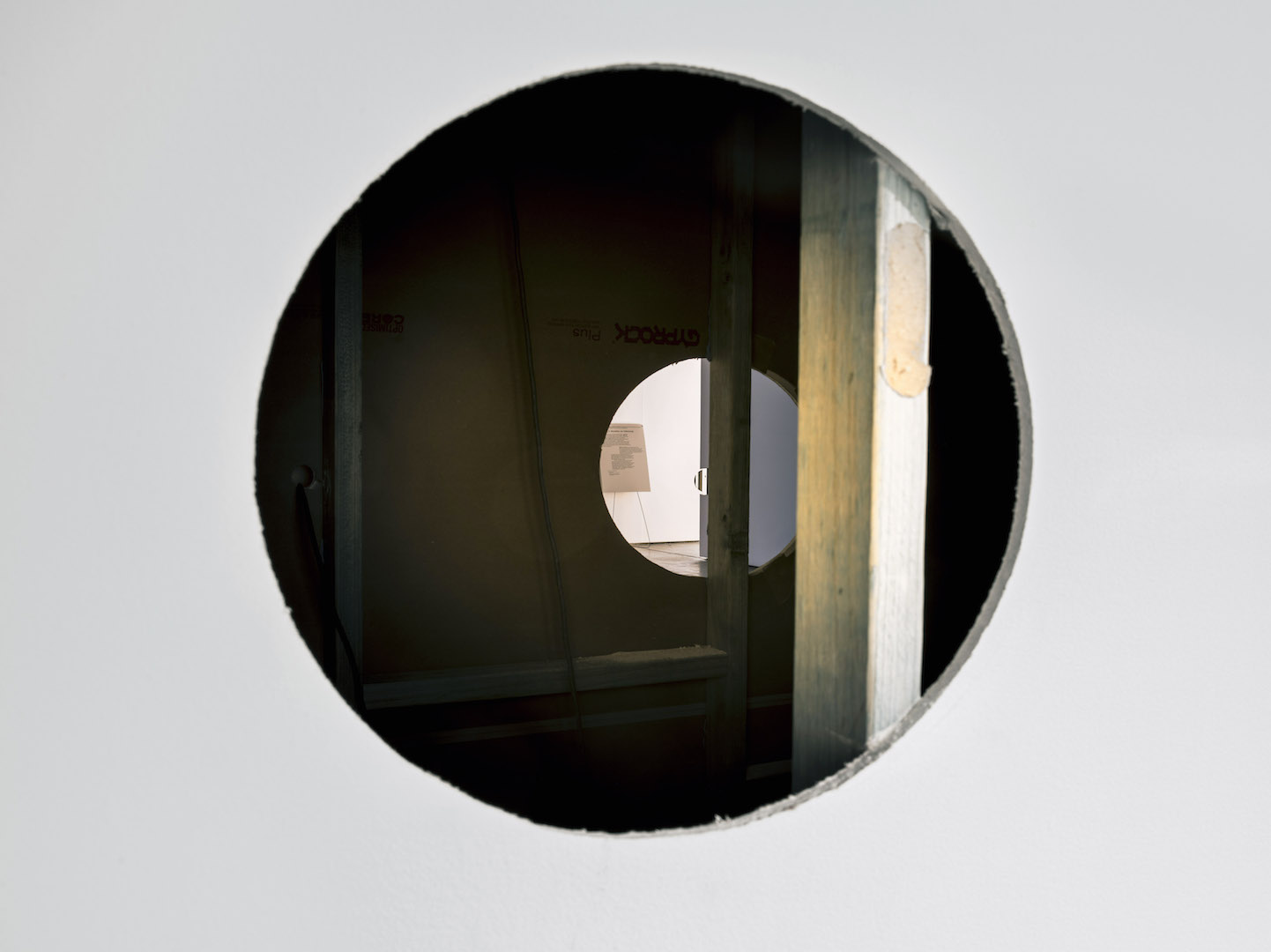
Kevin O’Brien: The origin of these holes in the wall is to do with bullets. I lived in Dublin for three years, and every day I used to walk along O’Connell Street past the Dublin Post Office (DPO). All the columns of this neoclassical building had bullet holes through them from the Easter Rising in Ireland of 1916. There were no bullet holes in the columns, but the mark—the sign of what had happend—was always prevalent. A century ago, the Irish managed to get the British out of twenty-six of its thirty two centuries. Within the context of this exhibition, I thought what could have happened if our people had got the British of Australia.
The mark of what you see now is more of an architectural idea because in having the wall cut, you can actually see what's in it. And it’s the same as those columns in Dublin; you see into the granite of those DPO columns where the bullets hit it, and you see how it reacted.
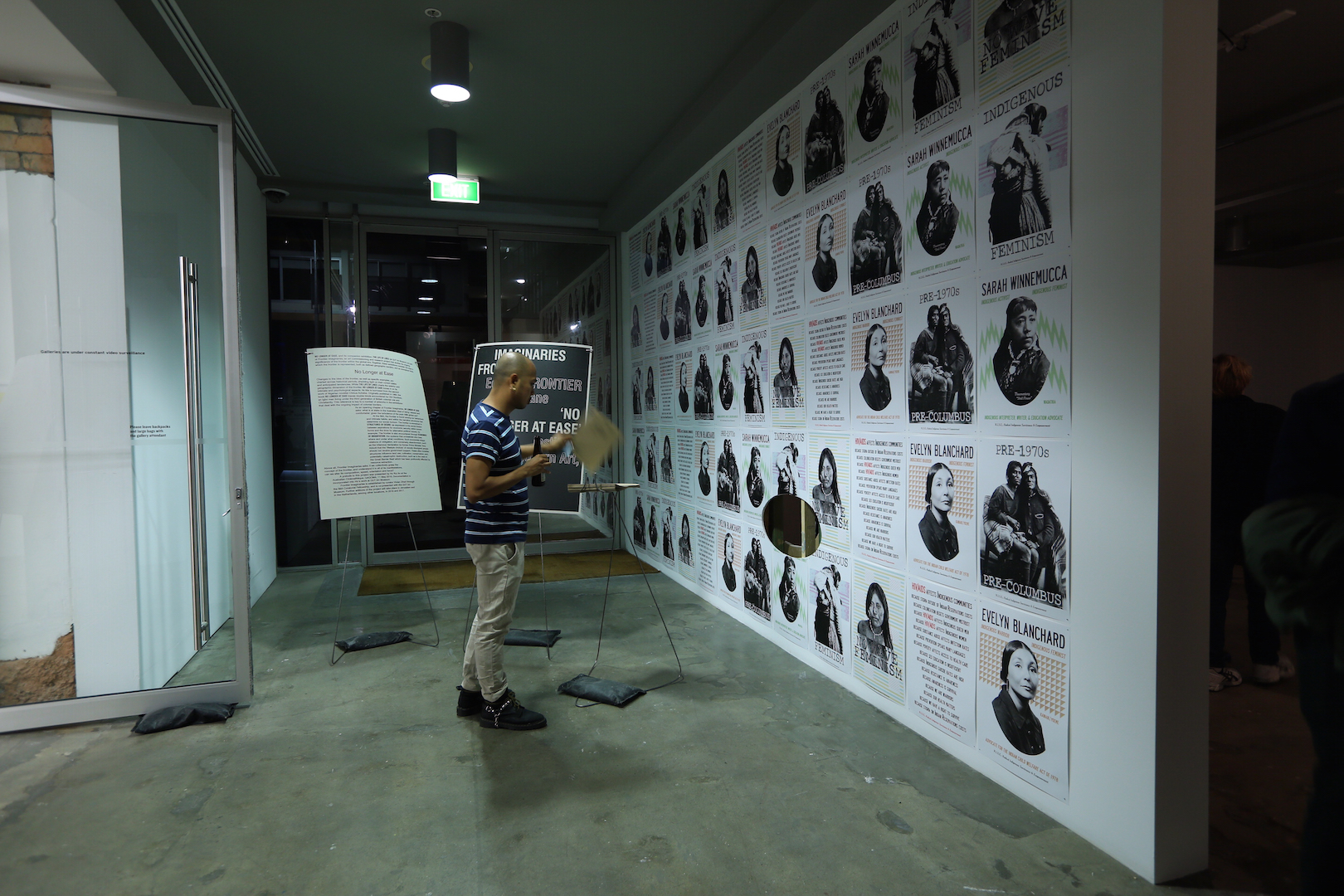
Above: View of entrance to IMA featuring exhibition signage and 'bullet hole' exhibition design detail.
Below: Close view of 'bullet hole' exhibition design detail.
Vivian Ziherl: And of course one of the first questions this evening was, is it a work or not? Is it something an artist made or is this part of the exhibition design? There is that question of what is proper to a practice, what is proper to architecture or proper to art.
Claire Humphreys: As architects, we work within the territory we are familiar with. If you need to provide a seating space for a bunch of people, how do you make it and how does it work? Gordon Hookey is going to be painting every day in the gallery, so we considered what that was going to be like for him. We started thinking about how to get a view back through to the footpath so that he wouldn’t get too crazy alone in there. That’s where the cuts through the gallery originated, and they eventually became bullet holes. They began in response to an architectural question.
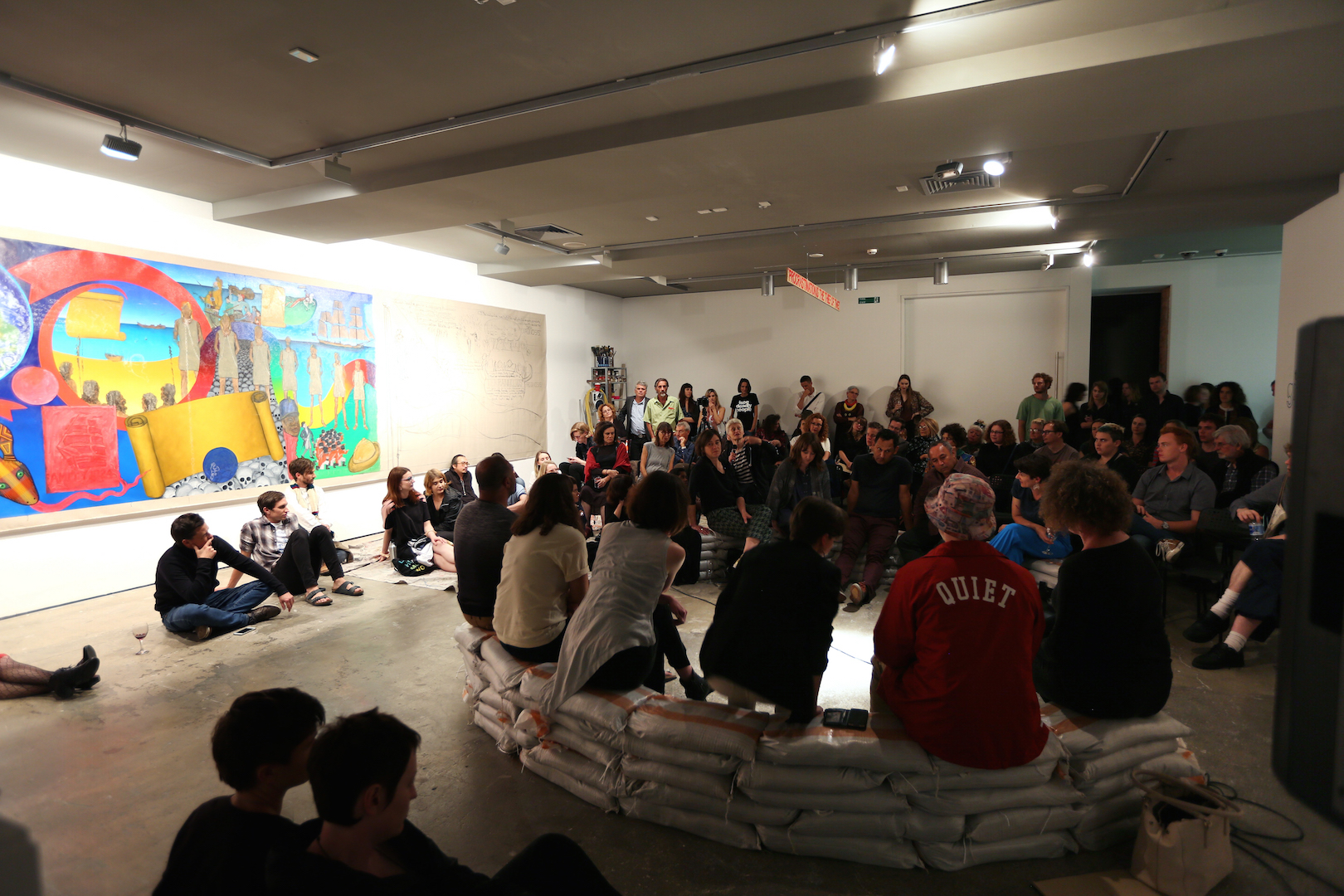
Another architectural question is the sort of materiality that’s appropriate to this exhibition. These sandbags were chosen for seating because they can be lifted by one person and easily assembled into a curve. They can be brought in and removed at very short notice, which means the seating could be added to if required. They have a pleasant tactile quality as they contain soil and sand. They were also chosen because of their multiple references to flood management, military usage, erosion control and temporary structures. The polypropylene they're composed of is also the material of those big bags that people all around the world use to carry their belongings with them. It’s just an everyday utilitarian material.
Rachel O’Reilly: Your exhibition design connects to some of my recent thoughts, and basically explains or offers up a logic for why, for example, an artist would be making drawings about fracking. It’s a question of the relationship between art and politics, art and activism—institutional spaces of professional artistic practices versus the challenge of the de-professionalization of anything in order for anything different to happen. One of the conversations that I have been having with one of my collaborators, Danny Butt, is about this question of how you denaturalise infrastructure in order to emphasise it as a thing. We are talking about this at the level of an individual or collaborative practice, but also at the level of an articulation that’s three dimensionally representational, or in the way that you organise around or through an infrastructural space.
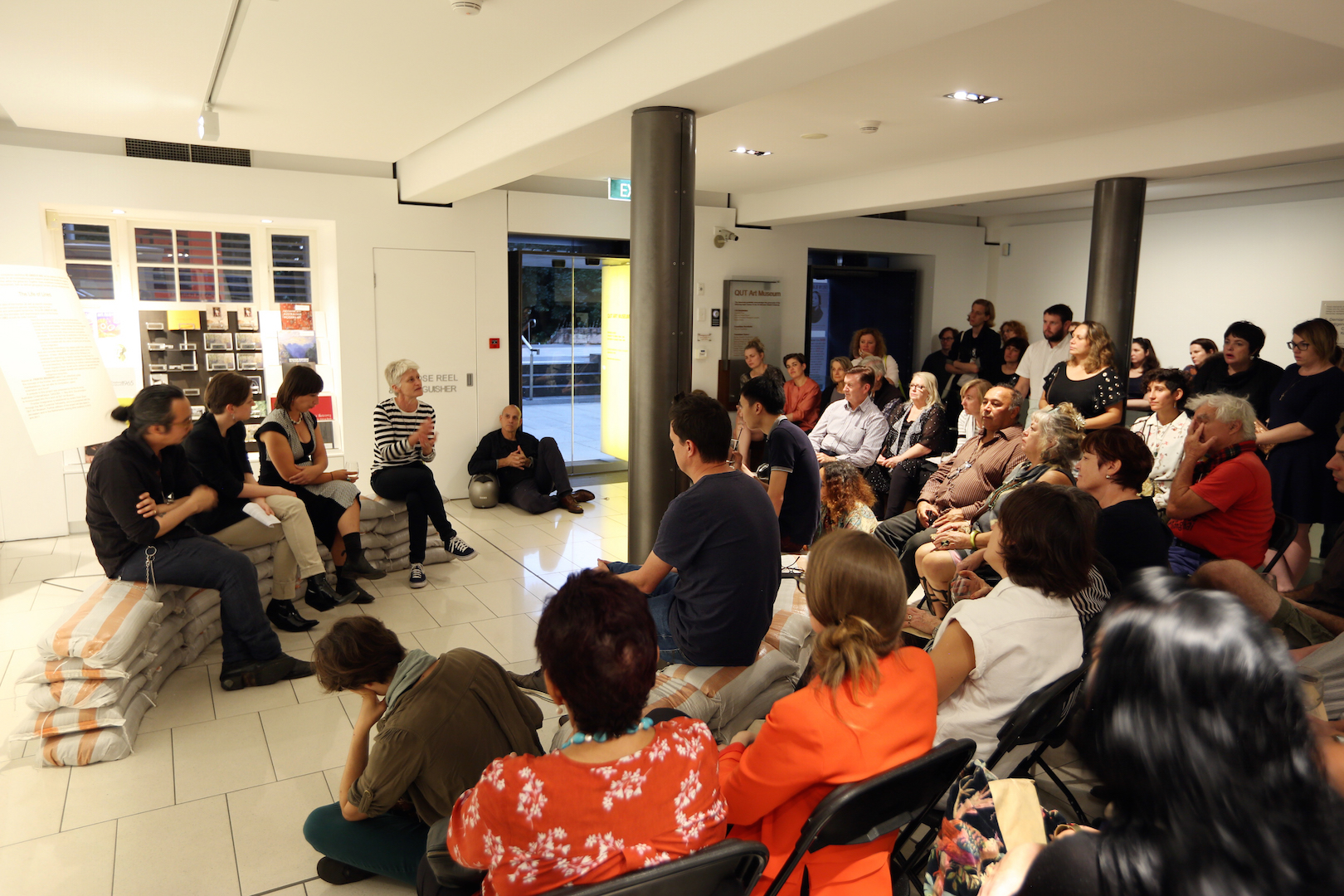
Above: Exhibition view of the Artist Assembly held at the QUT Art Museum on the exhibition opening May 14, 2016, and utilising the sand-bag 'assembly point'.
Below: Exhibition view of the Artist Assembly held at the IMA on the exhibition opening May 14, 2016, and utilising the sand-bag 'assembly point'.
In Australia, the level of force that was required to naturalise infrastructure was so extreme—and it was such a tenuous and ridiculously large space to pull together—that it remains an extremely radical position to even question the nature, norm, or ordinariness of an infrastructural project. So I really like that about your exhibition design, and I see it as threading together a lot of different practices that ask challenging questions about past, present, and future forms of life that will not and have not been able to naturalise infrastructure in the way that it has been able to be naturalised through, for example, our aesthetic inheritance of post-war states of times.