Richard Bell in conversation with Nuri al-Okbi
Nuri al-Okbi and Richard Bell (translated by Jack Persekian and Adania Shibli)
(Print essay)Nuri al-Okbi: I will tell you about my history and my place in Israel. I was born during the British Mandate. And after my father passed away we found a paper written by my father saying that I was born January 20th 1942. I remember vividly how Israel occupied Bir al-Saba (Beer Sheva) in 1948. I remember a low flying plane over our houses and people. We lived around ten kilometers north of Bir al-Saba and we could hear the explosions. I was so scared. My siblings were running to our mothers. They occupied Bir al-Saba and asked Sheikh Salman Imzayen who was a very famous sheik to come with a delegation. They set up a big tent in Bir al-Saba and sixteen bedouins sheiks went to this tent to make an agreement with the government of Israel through of course the army. They asked the bedouins to stay calm and to keep the situation quiet and under control. Israel in return would respect their dignity, land and weapons. Israel committed to these three things. Why? So that they can protect their sheep and cattle from wild animals. That’s why they could keep their weapons. How do I know about this agreement? My father was one of the sheiks and was the first one to sign this agreement. I remember the military governor who used to phone my house. And my family would slaughter ten sheep for them, in honour of the military guests. Not just out of generosity, also out of fear. I remember also how they used to eat the meat and the rice and afterwards the watermelons. I remember also the first elections for the Knesset and how they put the ballot boxes up, in 1949.
I remember the representative of the military governor asked his father, who was the sheikh, requested that all the family would vote for the government of Israel which was headed by Ben Gurion. I have a document where Avraham Shemesh, a representative of the government, asks his father to ask all the veterans who live in the periphery of the land to return and live inside the land that was under his father’s jurisdiction. I remember one early morning when they came and started shooting at a mule and they forced everybody together in front of their tent. We had these ID cards that Israel issued us and the representative of the military had a list. They asked everyone to present their ID card. He would say to some ‘you have no place here in Israel so go to Jordan within 48 hours’. This ID has blue and white stripes and the occupation was that they were all foreigners. He would ask for reports of the amount of crops, what are the produce they produce, the quality, the type, everything. The lands that belong to the people who had left or were forced to leave belonged now to the people who were staying.
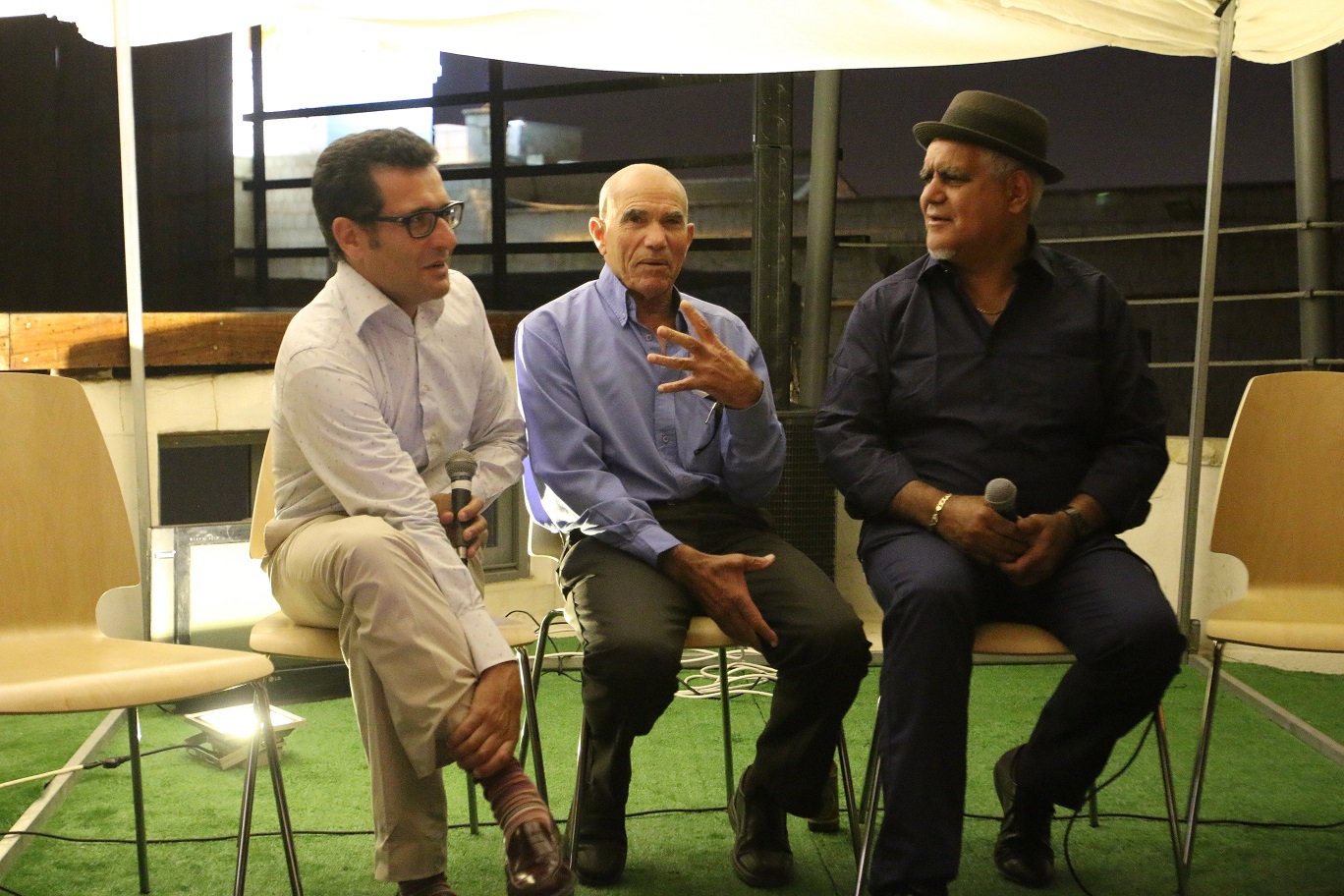 Richard Bell in conversation with Jack Persekian and Nuri al-Okbi Embassy, 2013–2016
In July/August 1951 they informed us that we needed to leave Al Araqeeb and in November they kicked us out. Again, they repeated the same. They came early morning and they put our stuff in military vehicles and they moved us to the Hura region. We were under military rule for 18 years. But this does not only apply to my village but to all the bedouins who were living west of Naqab between Gaza and Bir al-Saba. Then they put us all into this area and they decided that this area does not qualify for the Compensation Plan, a plan that Israel has for drought years. There is a line, the drought line, and people up to that line are compensated but this place was outside that line. In the place where we used to live before we were moved, there was a kibbutz four kilometers away from us and it so happens that when we were moved from our land and towns, the kibbutz was not moved but enlarged and other settlements build in their place.
When they moved us in November 1951, I was nine years old. I just finished my third year in school. In this new place where they send us there was no school and no water. We needed to wait for the rain to come. (I saw a very nice film actually, Wutharr, about the importance of water!)
This board that is here from Richard Bell’s Tent Embassy, it says “WHITE INVADERS YOU ARE LIVING ON STOLEN LAND”, I want to change the word “white” with “Zionist”.
I want to mention one particular person Amos Mokadi, an employee of the Israel Land Authority. He told me, ‘if you’re asking me about agricultural towns or cities for Arabs, we did not come here to build anything for Arabs, we came to build for the Jews.’ I told him we need equal treatment. I have asked an employee from the Jewish National Fund, why are you planting this particular kind of tree and the guy told him ‘so that we can grab the land’. The plants, they actually grow them from Australia!
I write regularly in a local newspaper The City. It’s distributed in what is called the ‘mixed cities’: Lid, Haifa, Ramleh, etc. See, I have no problem with the Jews, I have a problem with racism. I need equality. It’s not imaginable how there is 200.000 peoples in the Naqab and not one single one owns one piece of land or water in his name.
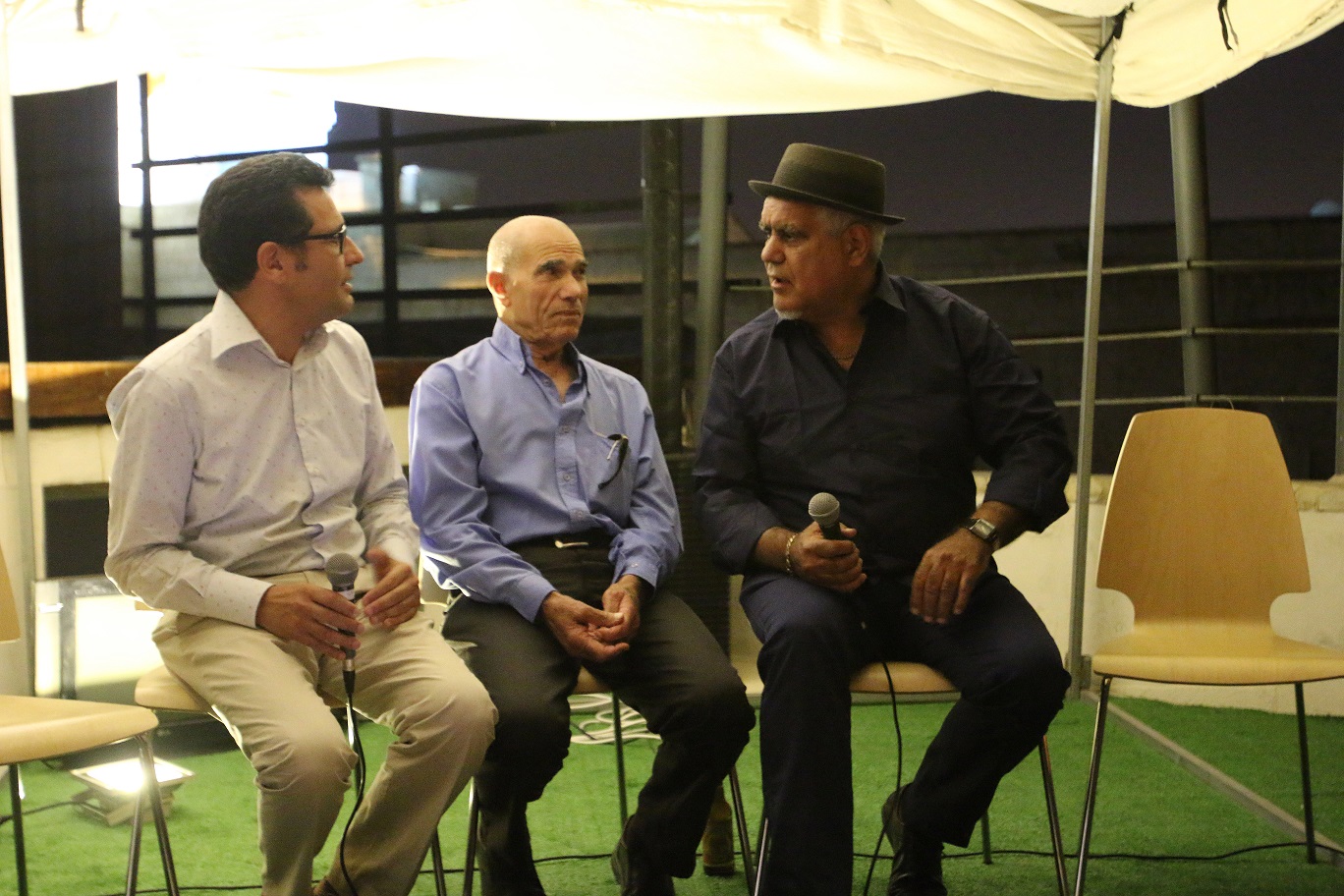 Richard Bell in conversation with Jack Persekian and Nuri al-Okbi Embassy, 2013–2016
Richard Bell: That’s very generous of you. Just to want equality. That’s a very noble response.
NaO: We also need to question the Israelis, take them to trial for what they did to us.
RB: That’s a very diplomatic response.
NaO: 500 families have formally requested from the state of Israel to build moshavim, which are agricultural settlements, similar to those the Israelis have. We would be happy with only 20% of the land and 25% of the water that they give to the Jewish. This way each family would become a productive family instead of being dependent on social security and money from the state. They never answered us. They don’t even consider us. We did a hunger strike for 13 days. There were 800 people. The head of the police of Arad, a city south of jerusalem, came and told us it was an illegal gathering. There was one kid (I think who can with the police) who threw a stone at the police car. They fired and destroyed the whole gathering. The hunger strike was because state confiscated 100 million m2 of land.
RB: That’s an amazing story and a story from generosity from the oppressed. A very civil and familiar story.
Question from the audience: What would you say are the demands of the Aboriginal Australian’s, given that you find the Bedouin’s request so civil? Is it ‘just equality’.
RB: I want it all. That’s a position that I need to take. When we’re way behind everybody else and in every sector of our society is positioned above us, for us to just have equality now would not work. There is structural poverty that we are afflicted with. If we just got equality now we would not have any kind of wealth, and this is a capitalist society, from which to build some kind of stability and income streams into the future. For us, just equality is not enough. We have to get programs which help us move forward. We weren’t legally allowed to own land in Queensland until 1989. If a family from three generations ago was able to buy a house, they would pass that house on to their children. In today’s world, that one house would be able to leverage five different houses and they would be able to build wealth from that. We don’t have that. We need financial compensation. We need land. And not just in the desert, because we don’t all come from the desert. They took all the land from us people on the East Coast where all the land was and still is. So we would need some of that as well. My position is: I want it all.
Quinsy Gario: But can I also say that the use of the word ‘civil’ is kind of odd? You’re striving for what has been taken away from you, so how can you be civil? Why should you be nice? You should be aggressive in fighting for your land.
NaO: There are 2 million Palestinians citizen of Israel. And that doesn’t mean that they don’t know what it means to be under occupation, they are also under occupation. This proves that if Israel really wanted peace they could have started with the 2 millions that are already there. I brought documents that proves we have been in this land for 210 years and we didn’t move and they did not accept that. And they said I feel pain for you, I can’t compensate you for millions, but I said I don’t want millions, I want my land back. Then they refused our case and they fined us with 50.000 shekels, that’s about 200.000 euros for the procedures. It’s the same thing as you been describing Richard.
RB: Exactly, it’s problems of empire. All over the place where we have discussions, we’re talking about how all the Indigenous peoples from all around the world have been colonized. We all have the same problems. You recognize this, we recognize this, other native people all recognize this.
NaO: Well, the colonizers entered Australia 200 years ago and you’re still struggling. Here the Israeli government was established almost 70 years ago and it is still going, it will not stop. We should never give up, we should continue struggling.
RB: I’d like to say one final thing: I’m sorry for the trees!
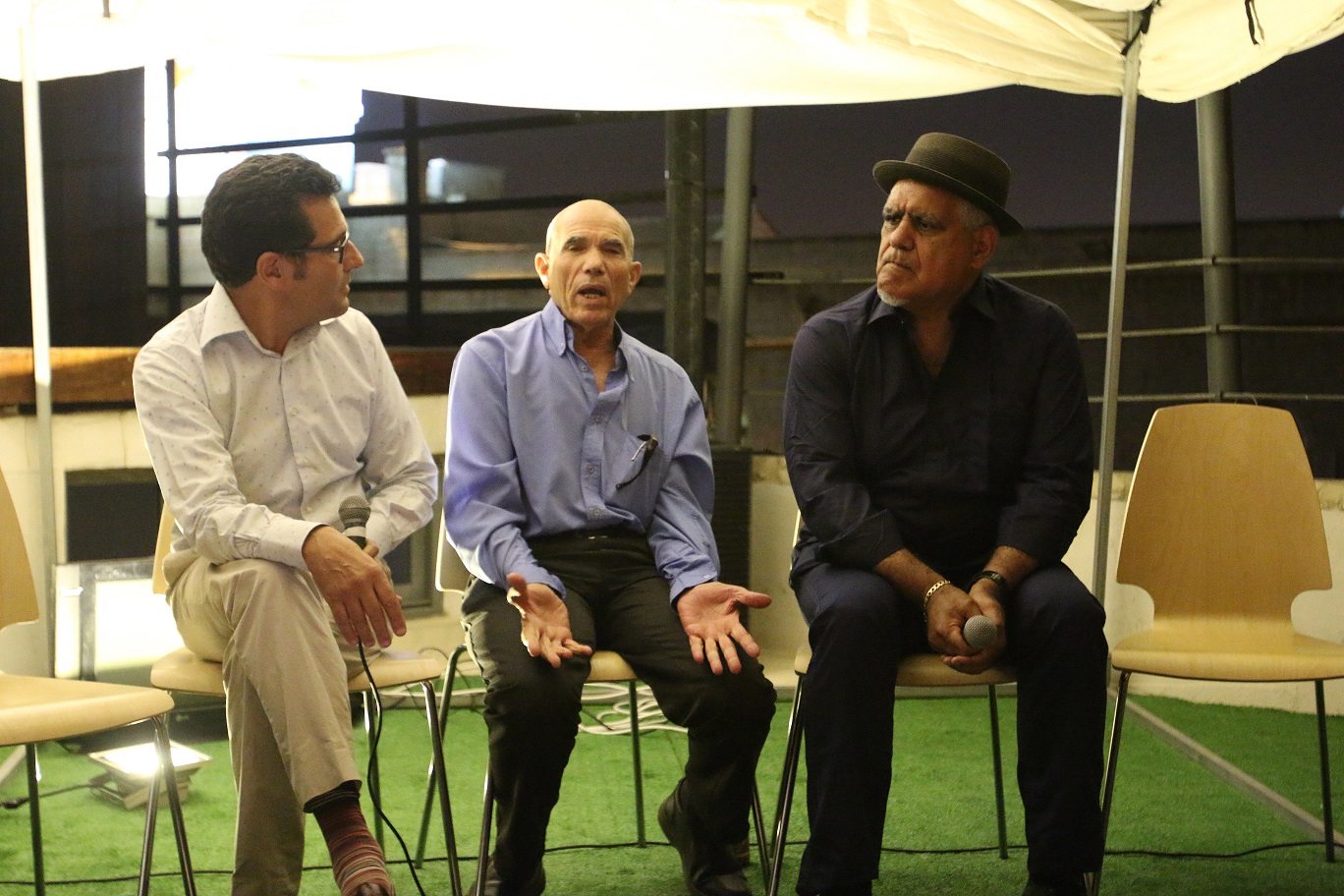 Richard Bell in conversation with Jack Persekian and Nuri al-Okbi Embassy, 2013–2016