The Frontier Image: What Just Keeps Representing
Michael Aird and Gordon Hookey in conversation with Vivian Ziherl
(Print essay)Vivian Ziherl: Michael and Gordon, I'm keen to discuss with you both what a 'frontier image' is and what image-making from a frontier situation involves. Michael, I am interested in your reading of the economies surrounding frontier photography in Queensland. Gordon, I think there is a certain kind of labour implied in your work; as a starting point, how does the frontier take form in this new work of yours, MURRILAND!?
Gordon Hookey: I think everything that I do is related to the frontier. As a blackfella, I think we still live on the frontier. I often describe my art as being on the interface where other cultures converge with black fella culture. I address issues and concerns on that interface, which could also be described also as a frontier. One thing that I like about Frontier Imaginaries is the "imaginary" part of it. So much of my work is about imagination and- as [urban Aboriginal artist] Richard Bell has said- of ‘imagining victory’. That’s something I always do. I always imagine victory. It’s got to be in everything that I do when it comes to making art or making pictures.
Gordon Hookey
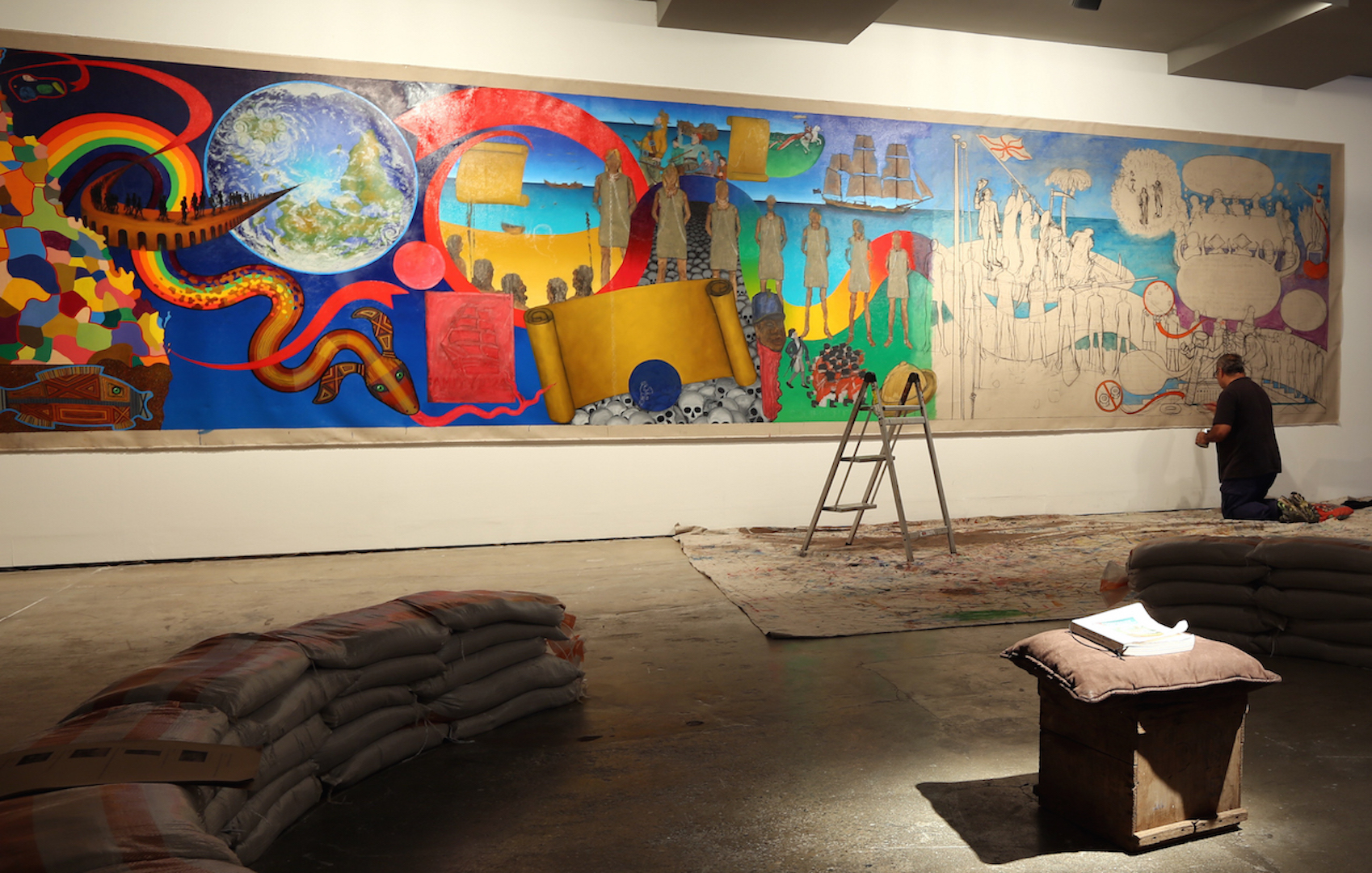
MURRILAND! 2015-ongoing
Oil on canvas, 210 x 1000cm
A Frontier Imaginaries commission, courtesy of the artist and Milani Gallery.
Vivian Ziherl: The painting that we’re sitting beside here is, as you say Gordon, "a long painting", and one that features many historical events that aren’t widely discussed in Australian settler society. There are very current public debates as to whether Queensland’s history of conquest and dispossession should appear in schools.1 These debates have been framed as a 'culture war'.[^2] Perhaps that’s part of the threshold that you’re talking about, and a way in which the frontier takes place in the present? How do you see it, Michael?
Michael Aird: The canvas spreads over time. There are old and more modern things in here, and that’s how I always think of the frontier: a moving line. But, going back to the pure sense of the word frontier, I think in most places in Australia it was a brief period—often only a decade or two, especially around here in South East Queensland—of a land-hungry aristocracy, generally English and sometimes Irish, Scottish and other Europeans.
The Europeans really wanted the land. They were going for the big land-grabs and anybody who got in their way was killed. It was a ruthless period and that’s what I see as a "pure frontier". For the Gold Coast, Brisbane, and the Greater East Queensland region, it was short-lived because those really land-hungry aristocrats had to give up some of their control to the next generation of immigrants—the lower class English, Scottish, Irish and others who came.
The government started breaking up their big land-holdings and handed them to this next generation of people. With that came an element of educated society; people such as doctors, police, clergy, press, school teachers, and other bureaucrats who had some sort of education and a 'degree' of social conscience. I’m not saying they were not racist—some of them were not 'good people— but they had a degree of social conscience. It meant that the really ruthless activities that happened during the pure frontier couldn’t continue as easily. I’m referring to the very populated areas of South East Queensland in the 1860s 1870s. But where Gordon comes from in the North-West, there were some ruthless aristocratic land owners carrying on horrific practices until well into the 1900s. And I think that’s Gordon’s big point that he can talk about; has it really stopped?
Gordon Hookey: I imagine the frontier as changing all of the time. In many ways, we have inherited all those horrific things that happened back then. Just look at the different figures from the census of education, incarceration, of health and all of that.2 That tells me that things are not alright; that tells me that the frontier like it was way back then exists in a different form. We’re still battling, or fighting, or warring, but in a different kind of way.
A while back I had a studio that was overlooking 'the Block' in Redfern, Sydney.3 Coming from the train station, I would pass some of the Koories down there.4 They told me that there were two levels of the TNT tower rented by the police department just for surveillance of a whole block where blackfellas lived. When I got to my studio and looked out over Redfern and also the TNT towers, I created a painting called Cog Native Frontiers(1995), meaning cognitive —in the mind— and cog/native, playing with words relating to the original people of this country.
So thinking about it that way, the frontier is almost a trench, in the sense that you’ve got two sides that are pushing the boundaries from time to time— when someone gets locked up, or someone dies in jail, or there’s a police raid for drugs.
Michael Aird: The more I study photos of Aboriginal people in Brisbane in 1860s and 1870s, the more I see a degree of agency. Even though a lot of people look at these photos and feel tat the subjects look uncomfortable—well, they were uncomfortable, they had their hands screwed into clamps and had to stay still for long exposure times of possibly over a minute, so of course no one looked happy in an 1860s or 1870s photo—they were doing pretty well in the sense that they were having genuine interactions with the white people here in Brisbane.
They would have come into town and probably not have felt like outsiders. They were trying to get resources, European commodities, and were probably prepared to work or trade for them. I’m thinking that these guys could walk down Queen Street and shopkeepers would probably have known them by name. I mean, you start getting this feeling that they were doing okay and had a degree of control over their life. Remember that back then, the government didn’t have the resources, they didn’t have any aboriginal policy, they weren't these ruthless aristocrats running the show. But it wasn’t as good for people in the 1890s and around 1910 because that’s when the government started getting organised and formulating really racist policies.
In the half or so dozen or so years leading up to 1897 [when the Aboriginals Protection and Restriction of the Sale of Opium Act was passed], the government was setting up reserves and encouraging people to come there as workers. There would be education for kids, there would be food, and it was a place where white people could source Aboriginal labor. Therefore, people moved there because there were some benefits, and they could get work if they went there. The Europeans would come looking for laborious. But then in the 1900s it changed: Aboriginal people were forced to move to reserves and were really being victimised in a different sense.
Vivian Ziherl: In terms of this quite epic form in the telling of a colonial history, the reference and start-up point to Murriland! is a series of 102 canvasses that were painted by the Zairian/Congolese artist Tshibumba Kanda Matulu in 1973/1974. The reference has been very fruitful in sparking the notion of this scale of painting. But there are many incommensurabilities—for one, Tshibumba was painting from the point of view of the African post-colony whereas your work takes place within the ever-receding horizon of a settler-colonial present. How have you navigated this transposition.
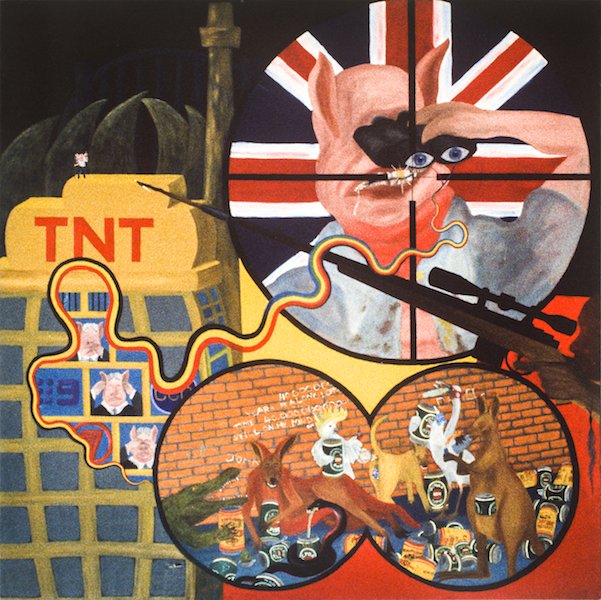
Gordon Hookey
Cog-Native Frontier, 1995
Oil on canvas, 152.5 x 152.5cm
A Frontier Imaginaries commission, courtesy of the artist and Milani Gallery.
Gordon Hookey: I think Tshibumba saw himself as a historian. So he knew exactly what he was doing and there was an accountability in his role. Reading the transcript there, he wanted to get things right, he wanted to paint or do pictures of fact.5 To me, fact is like a point: even if something is written that doesn’t mean that it's truth. As I said, I am not a historian; I am an artist. And my art is about history, but is not painting history.
It's interesting to think about at what point an event becomes history. At one point, I was working at Woorabinda, based in Rockhampton, and there was a scenario where two little boys walked off the community and got lost. They were missing for almost a week. It made nation news. They had helicopters, trackers—you know, SES [State Emergency Services]—looking for them; everyone was out there. And there were reports and bulletins in the Rockhampton newspaper every day, and people were generally glued to the story.
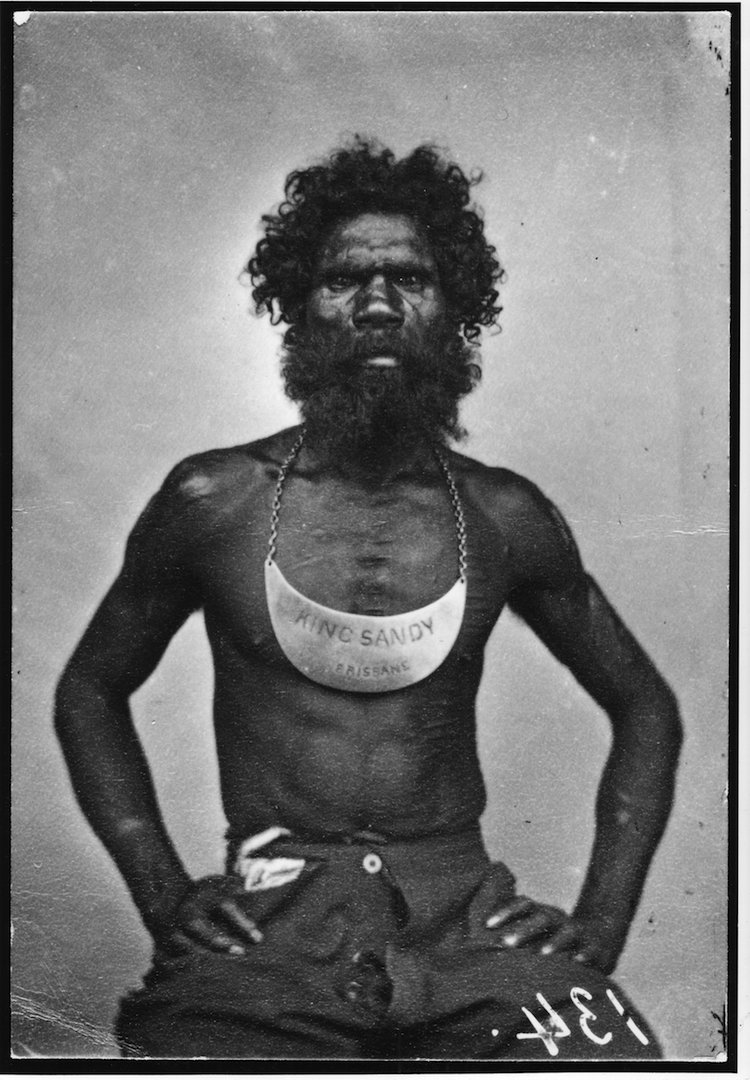
Kirwallie Sandy, George Street, Brisbane, ca. 1870
Photograph: Daniel Marquis.
Courtesy State Library of Queensland 169645.
But what had actually happened was that they after five or six day, the two boys walked out of the bush into one of the properties and everything was airtight. But they were covered in thick mud all over. It was stuck to their hair and everything. The story that they told was that just after dark, a little bird was calling out their names and asked them to come, and they followed this little bird into the darkness and got disorientated and lost. While they were lost, an old man came to them and told them to cover themselves with thick mud to protect themselves from the mozzies, and thickly too so they wouldn’t be cold, and to dig into the creek for the water. This old man was there with them for the days that they were lost. This was the story that the boys told and it was printed in the papers.
Years after that, when I'd moved down to Brisbane, and I was at the Maleny Folk Festival—probably the inaugural one—heard over he loudspeaker something like "the Woorabina dancers are performing on the main stage, come and have a look". So I went there and they came out and did this welcome dance, and then the next minute they told a story from their home. Those dancers done a dance of that very thing that happened five or ten years before, which I bore witness to in a different kind of way.
But they had done that whole dance, the song, and everything, and to me it like made my blood go cold—you know when you get that cold goose bump feeling—because it was just so moved by it that it became part of culture or tradition. So I don't underestimate any event. And I think that every Indigenous community, from Cherbourg to Hopevale to Palm Island, has that element.
Michael Aird: The government thinks of Aboriginal cultural heritage as just archeology. And the sad thing is that people argue about protecting sites from being bulldozed and generally they do get bulldozed because there isn’t much of an academic debate and there isn't real government protection for those forms of Aboriginal cultural heritage. Yet there are so many other aspects of cultural heritage like Gordon just described, and there is no protection for these other aspects of culture at all.
At least there is a debate about culture—largely thanks to artists. Because, as I said, the education system and the mainstream media and in the tourism industry are doing a pretty pathetic job of protecting, documenting and telling Aboriginal history. It’s the artists who are at the forefront. Like who would think of putting [right-wing media commentator Andrew] Bolt into an Aboriginal artwork? But guys like him are part of Aboriginal history and culture; they need to be discussed because they are a problem. You know, they need to be discussed just like Captain Cook. I love seeing Captain Cook referenced in art because I just think he’s such a character. He marks such an important point in history. I did the pilgrimage to Whitby just so that I could visit where Captain Cook came form.
Gordon Hookey: I went to Whitby too.
Vivian Ziherl: Really— you've both visited that particular site in the UK? Wow... I don't think I could've named Whitby. let alone told you that was a place connected with Cook. What explains that?
Michael Aird: Arthur Peterson was this old Aboriginal fella who came and lived with me in Brisbane in 1988—and Gordon knew him well—and Captain Cook was part of his language. He referred to Captain Cook as the bringer of a new tradition. To him, Captain Philip, Captain Cook, Jesus Christ and the Queen of England are all the same person: just call them Captain Cook. Look at Paddy Fordham form Arnhem Land. He’s done a painting, Too Many Captain Cooks (1985).
Vivian Ziherl: Why Captian Cook and not Philip, who presumably wrought more physical carnage, for example?
Michael Aird: Well, because Cook's the iconic European explorer. I started school in 1969 and every school-kid in Australia got given a book about Captain Cook to celebrate [the bicentennial] 1770 the following year. We’ve been brought up with him being this hero. And of course you were not allowed to criticize him.
Gordon Hookey: It's what he represents. He’s emblematic of everything. Because he was the one who stuck the flag into Possession Island to claim of the whole continent, which I cant make sense of.
Michael Aird: And even though early Australia had large numbers of Chinese—especially Queensland—and all these other races were present (particularly Malaysians, Indians, South Sea Islanders and people from the Middle East), they all get written out of history, and the English keep taking over. So, again, Captain Cook represents the English, and their domination of history. He represents all the lies.
Vivian Ziherl: And what about Captain Cook here in this canvas?
Gordon Hookey: Well, see, what’s happening in this scenario here is Parliament House there and the text that Andrew Bolt is saying is something like... "in no uncertain terms, Australian indoctrinators, the pervaders of thought and a prominent expert on history, race and colour, tells it like it is". And this is what he says, probably using swear words; "youse [sic] ungratefuls..., if it wasn't for Captain Cook, youse black bastards would still be eating your food raw." All I'm doing is turning the language on Captain Cook, saying he can cook.
Vivian Ziherl: LOL!
Michael Aird: That’s why I love Captain Cook; there’s so much silliness to do with him. He just keeps representing…
-
Shortly before the Frontier Imaginaries exhibition of No Longer at Ease opened at the IMA, the place of colonial history within institutional curricula was again in newspapers, with the Queensland Premier Annastacia Palazczuk's public acknowledgement of the British invasion of Australia rather than a narrative of discovery; see "Queensland Premier Praised for 'Invasion' Stance in Australian History for Indigenous People", ABC News, 30 March 2016, http://www.abc.net.au/news/2016-03-30/palaszczuk-praised-for-australian-invasion-stance/7286434.
[^2] The intimate connection of extractive industry interests with the propagation of divisive culture-war discourses is outlined in detail in Mark Davis, "At War with Ourselves", published in the recently de-funded Meanjin (Winter 2016). ↩ -
See 'The Gap: Indigenous Disadvantage in Australia' www.australiantogether.org.au/stories/detail/the-gap-indigenous-disadvantage-in-australia ↩
-
'The Block' refers to an inner-city compound of residential buildings that were established as Aboriginal-controlled housing in 1972. The Block historically has been a site of Aboriginal protest and political organising and was founded during the Black Power era in response to widespread eviction in the area by local landlords. ↩
-
The Koorie People are Indigenous Australians of the areas now referred to as New South Wales and Victoria. ↩
-
A transcript of interviews that were conducted by anthropologist Johannes Fabian along with the commissioning of Tshibumba's canvasses is published in Remembering the Present: Painting and Popular History in Zaire (Berkeley, CA: University of California Press, 1996). ↩